CASE STUDY
Create T3 Chill App
MY ROLE
Open-Source Product Development
Developer Tooling and CLI Engineering
Full-Stack Product Engineering
Authentication, Access Control, and Billing Systems
Environment and Setup Automation
CLIENT
Open-Source NPM Package
YEAR
2025
TECH STACK
OVERVIEW
Create T3 Chill App came from a practical problem I kept running into: getting a modern full-stack product off the ground meant repeating the same setup work across authentication, database wiring, typed APIs, subscriptions, environment variables, and local infrastructure before the real product work could even start.
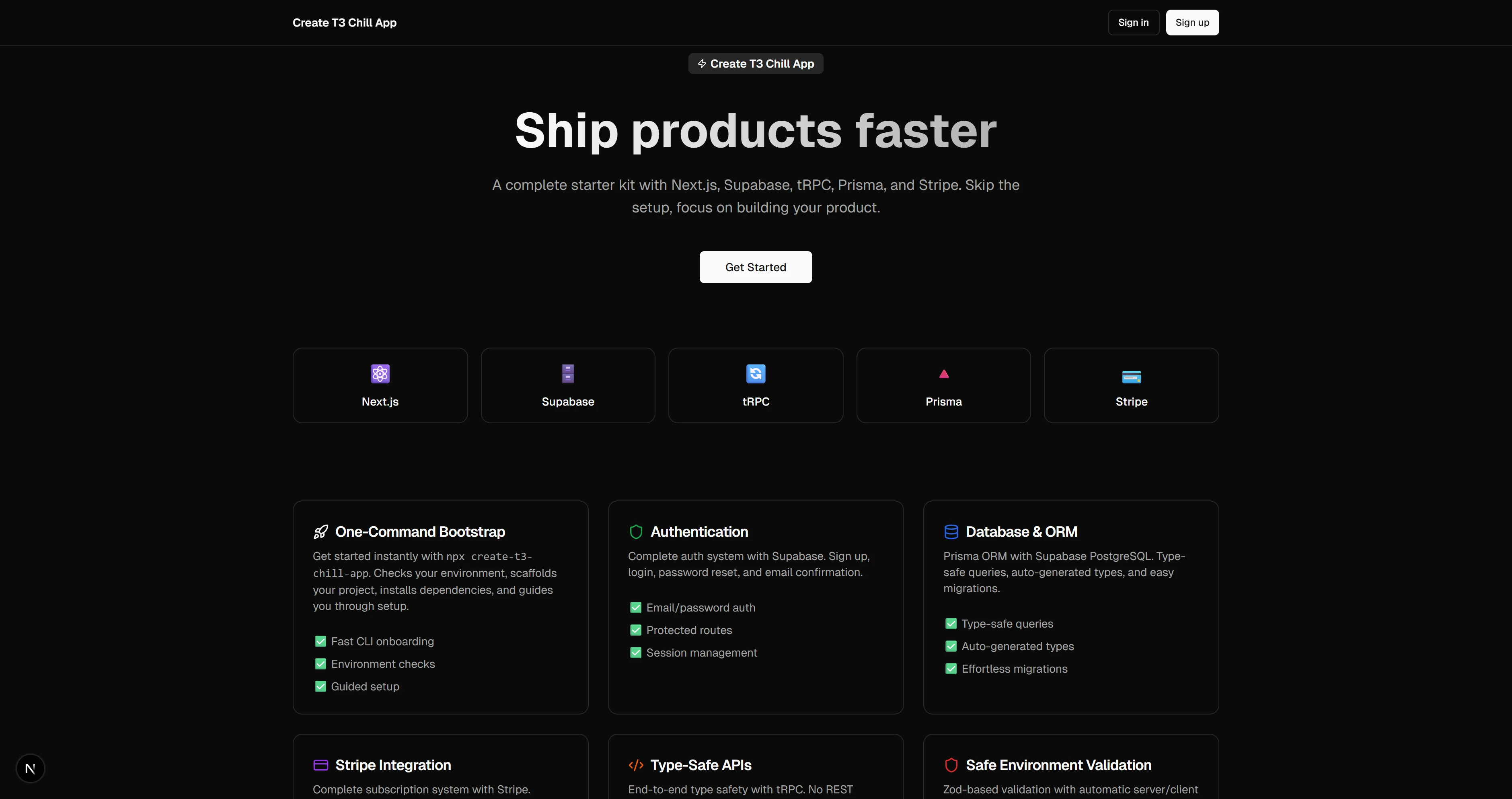
I built and released the project as an open-source product and published it as a public npm package, so developers can spin up a full-stack base with `npx create-t3-chill-app@latest` instead of manually recreating the same setup from scratch.
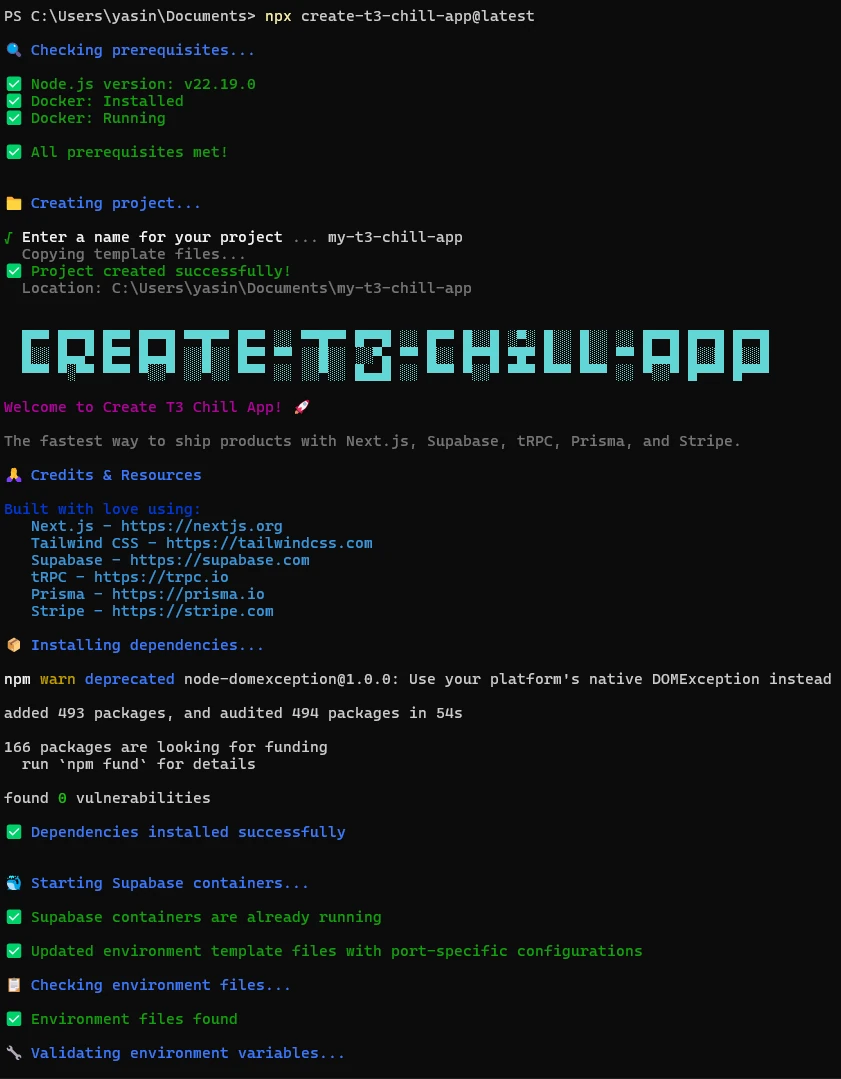
The generated app ships with sign up, login, password reset, email confirmation, SSR and client session handling, protected routes, and typed tRPC access layers built around public, authenticated, and subscriber-only procedures.
Beyond auth and API structure, the starter includes Prisma models, migration and reset scripts, Studio-ready database tooling, a subscription-aware dashboard, Stripe checkout, webhook handling with recovery paths, theme support, toast-driven feedback, and a setup guide so the scaffold feels like a usable product base instead of a bare template.
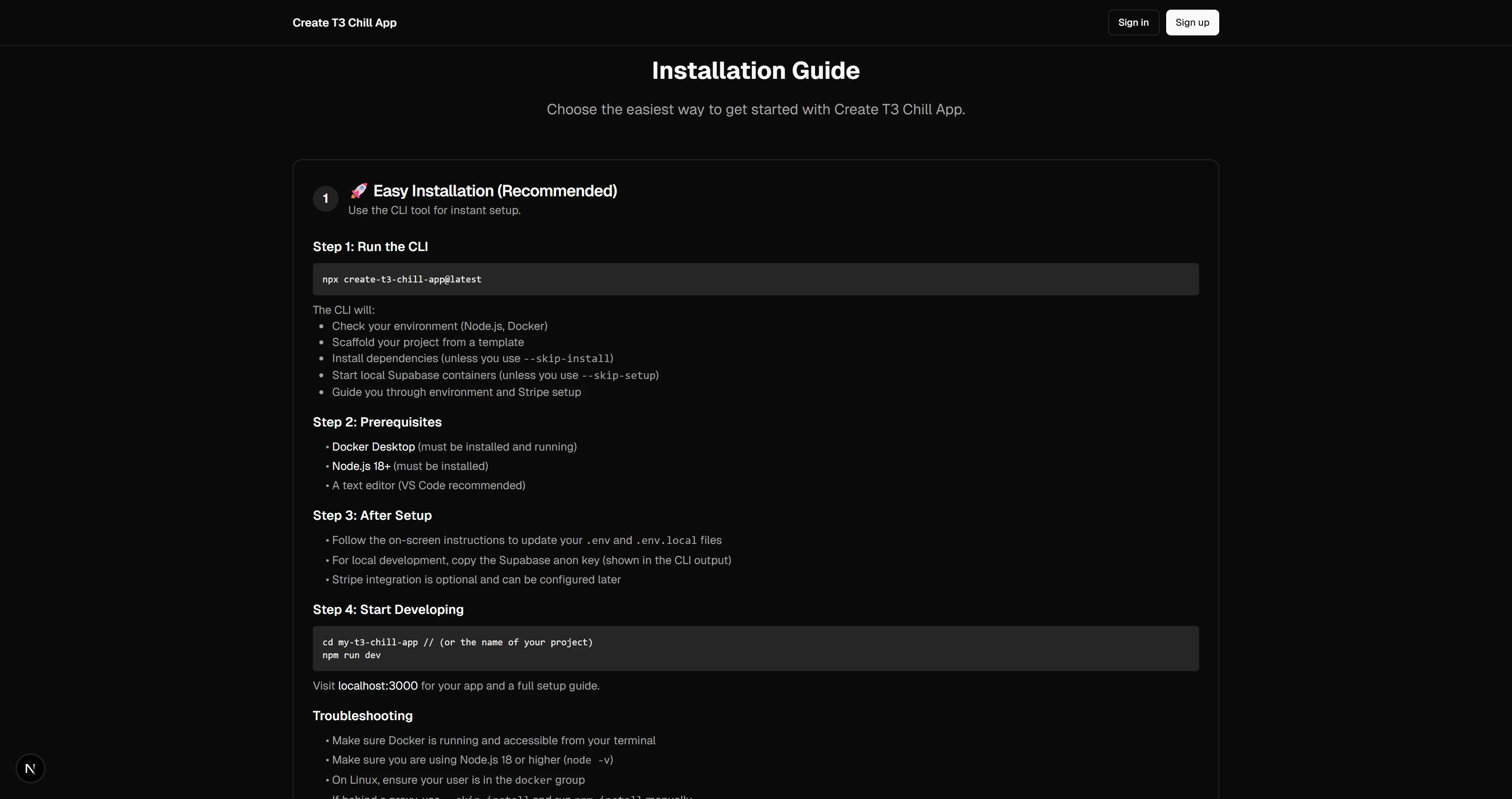
A major part of the work was the dev-tooling experience itself. The CLI checks Node and Docker, copies the template, installs dependencies, starts Supabase, allocates conflict-free ports, rewrites config and environment files, validates required values, and boots Prisma so a new project can move from zero to a working full-stack baseline with generate, migrate, reset, and local database setup flows handled cleanly.
WHAT I OWNED
- -Designed and built the starter app across sign up, login, password reset, email verification, protected dashboard states, typed tRPC procedures, and subscription-gated product surfaces.
- -Defined reusable access layers for public, authenticated, and subscriber-only routes and procedures so auth and authorization rules stayed clear across the stack.
- -Built the published CLI workflow with interactive prompts, prerequisite checks, template scaffolding, dependency installation, Supabase startup, port conflict resolution, env rewriting, and Prisma setup across generate, migrate, reset, and local database workflows.
- -Implemented Stripe checkout, subscription persistence, webhook processing, and protected procedures so the template includes a real billing flow instead of placeholder UI.
- -Added typed environment validation, Supabase session middleware, and polished starter UX details such as theme switching, toasts, and setup guidance.
KEY OUTCOMES
- -Turned a repetitive multi-step setup process into a guided one-command bootstrap for a modern Next.js stack.
- -Released that setup knowledge as both an open-source product and a public npm package developers can install, study, reuse, and adapt as a serious product starting point.
- -Bundled the core product foundation developers usually wire up separately: auth lifecycle, access-controlled APIs, database layer, billing, UI state, and local infrastructure.
- -Showcased strength across developer tooling, DX design, backend integrations, and production-minded edge cases such as port conflicts, placeholder config, and missed webhook recovery.
CLI Scaffolding Process via NPM Package
Scaffolded App Home Page
Scaffolded App Installation Guide